Where an AI prompt goes after you press send
The path is roughly the same for a chatbot in the browser, a coding agent, or a script that calls an AI API.
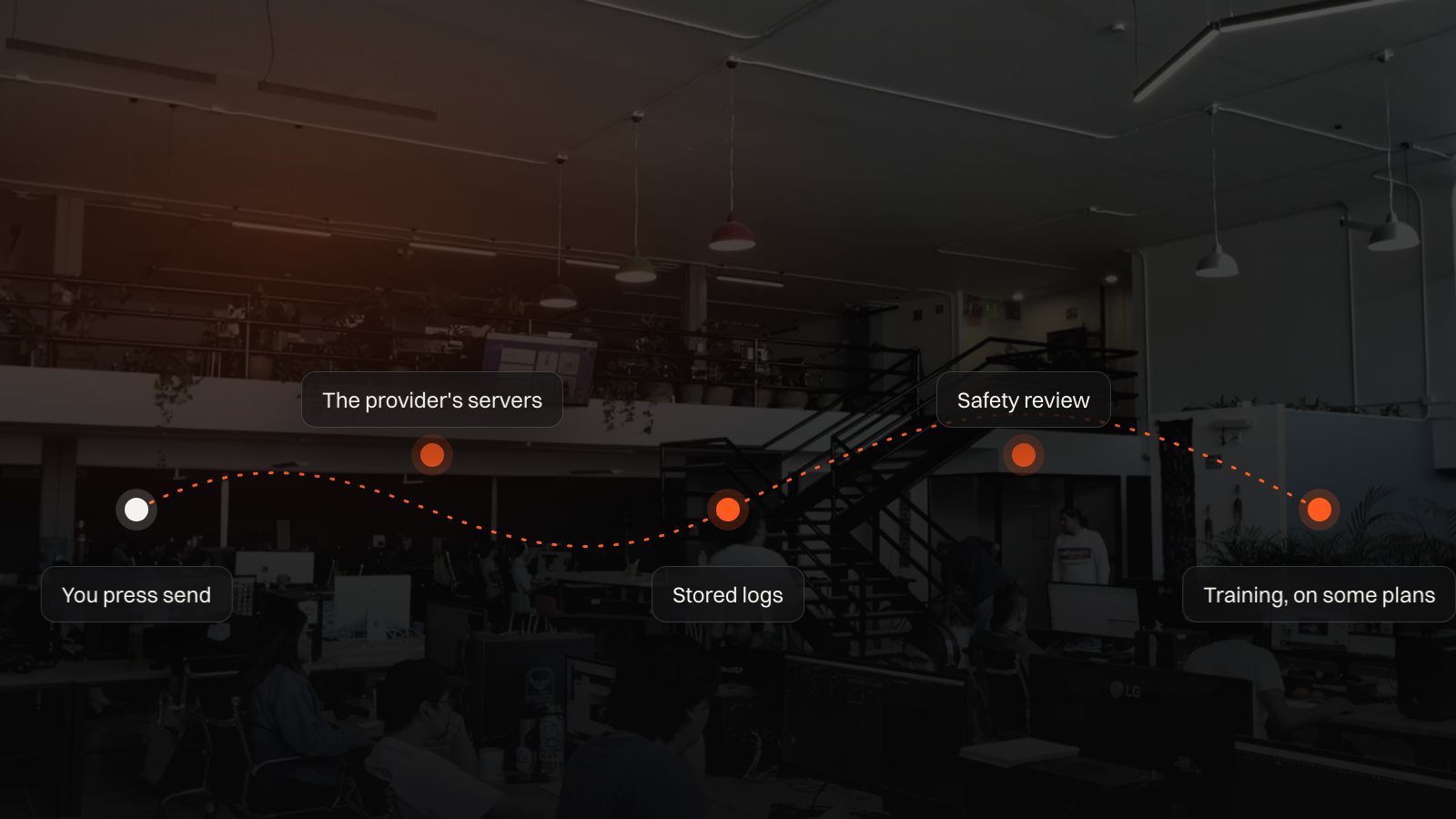
- Your device. The tool builds a request. It includes what you typed, plus any files, earlier messages and background instructions the tool attaches. Coding agents often add file contents and terminal output that you did not type yourself.
- The network. The request travels to the provider over an encrypted connection. On a work network it may also pass through a company proxy or security tool that can inspect it.
- The provider’s servers. The model reads the text and writes an answer. The text has to be readable at this point. A model cannot work on words it cannot see.
- Logs and storage. The provider may keep a record of the request and the answer. Reasons include showing you your chat history, fixing faults and watching for abuse.
- People and training. On some plans, staff or contractors may review samples of conversations, and content may be used to improve future models.
- Other companies. Some tools pass your request on to another company’s model, or to search tools, plugins and connectors you have switched on.
AI data retention, human review and training
Three things vary most between plans, and they are worth checking one at a time.
- Retention. How long prompts, files and answers are kept, and whether you can shorten that period.
- Human review. Whether people at the provider can read your content, and under what conditions.
- Training. Whether your content is used to improve models, whether that is on by default, and where the setting lives.
Free, paid, team and API plans from the same provider often have different rules. Do not assume the terms of one plan apply to another. Read the terms for the exact plan each person is using, including personal accounts used for work.
Questions to ask your AI provider
Send these to the vendor, or look for the answers in the plan’s terms and data processing agreement.
- How long do you keep prompts, uploaded files and outputs? Can we change that?
- Is our content used to train or improve models? Is the default on or off?
- Who at your company can read our content, and when?
- In which countries is our data stored and processed?
- Which other companies receive our data?
- What happens to stored data when we delete a chat or close the account?
How to control what you send to AI
You cannot change what happens on a provider’s servers. You can change what arrives there.
- Use the right account. Put work on a company plan with terms you have read, not on personal accounts.
- Check the settings. Look at history, memory and training options for each tool, and set them on purpose.
- Trim the prompt. Take out names, account and card numbers, passwords and keys before sending. The model rarely needs the real values to do the task.
- Watch files. Screenshots, scans and recordings carry private details that are hard to check by eye. Keep them back unless you have reviewed them.
- Limit coding agents. Keep secrets out of the repository and use ignore rules so agents skip folders they do not need.
- Review connectors. Each plugin or connector is another place your data can go. Switch off the ones nobody uses.
Privacy laws and AI prompts
Sending data to an AI provider is sending it to a vendor, so treat it like any other vendor decision. GDPR is the European Union law on how personal data about people in the EU is collected and handled. HIPAA is the United States law that protects health information held by healthcare organizations and their partners. If laws like these cover your data, ask your counsel how they apply to AI tools. This article is not legal advice.
Sealing private details before a prompt leaves
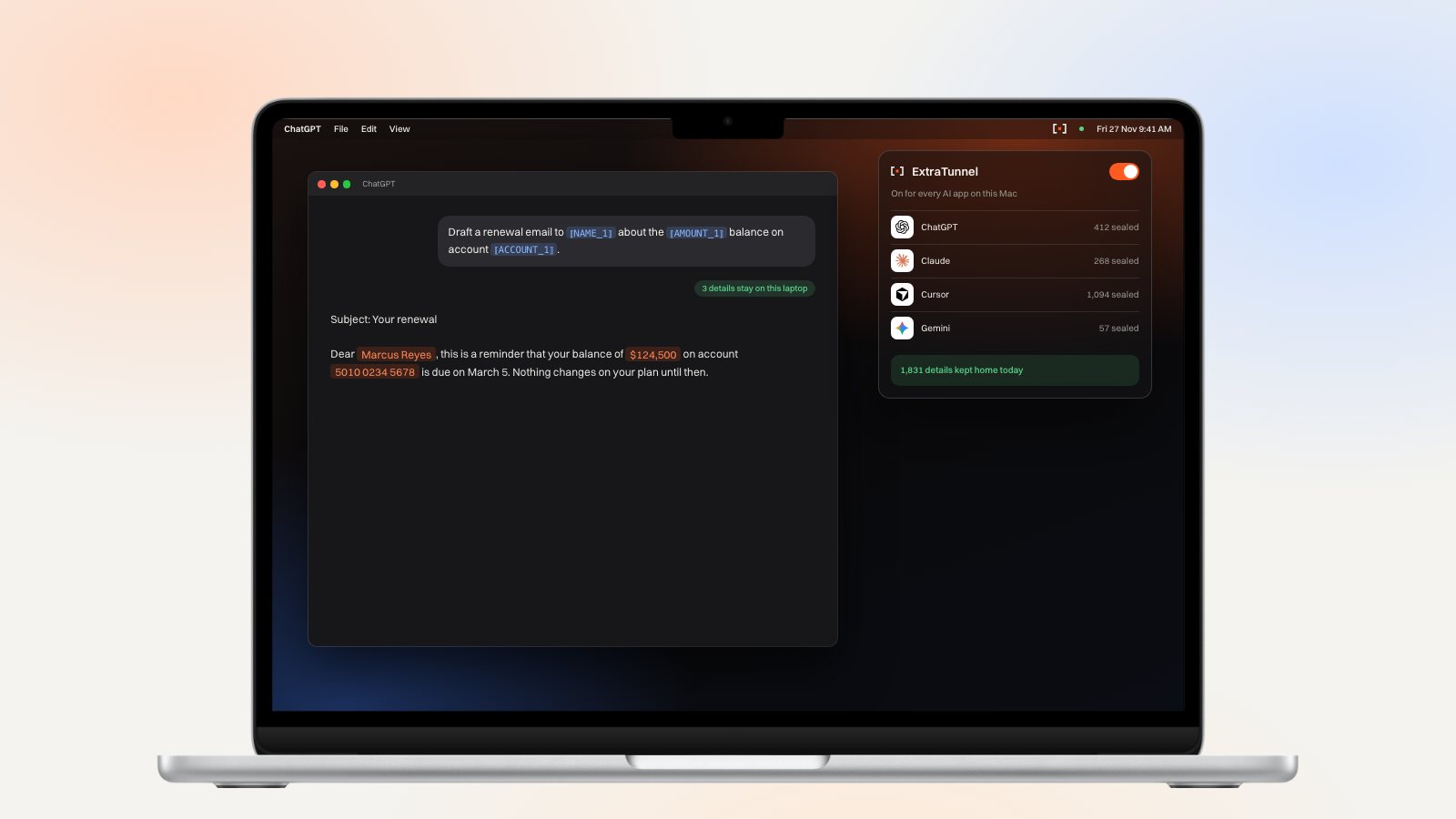
Trimming prompts by hand works until people are busy. ExtraTunnel is one way to do it automatically. It runs on the person’s own computer and works like switching on a VPN. Before an AI request leaves, private details such as names, account numbers, amounts and emails are swapped for labelled placeholders. The AI works on the sealed text, and the real values are put back into the answer on the computer.
A second, simpler program checks every request before it goes. If the check fails, the request does not go out. People keep the tools they already use. The apps are early preview builds, and no detector catches everything, so the provider questions above still matter. The security page lists what stays and what leaves.
Common questions
Does AI save what I type?
Often, yes, for some period. Most tools keep a chat history you can see, and the provider may keep its own logs as well. How long depends on your plan and settings.
Is my data used to train AI models?
It depends on the plan and the settings. Some plans use content for training unless you opt out, and others do not. Check the terms for the exact plan you are on.
Can people at the AI company read my chats?
On some plans, staff or contractors may review conversations for safety or quality reasons. Ask the provider who has access and under what conditions.
Does deleting a chat delete the data?
Deleting a chat removes it from your view. Whether and when the provider removes its own copies is set by its retention terms, so ask.
Is it safe to paste customer data into an AI chatbot?
Only if your contract with the provider and your duties to the customer both allow it. If you are unsure, remove or replace the private details first.